%20(36).png)
The Science Behind Curvora: Why Hips Hold the Power

Updated: Nov 12, 2025
If you’ve ever wondered why we focus so much on the hips—or what makes our movement different from every other dance workout out there—this is where it all begins.
Most workouts are about building strength or improving aesthetics. Curvora™ does both—but with deeper intention. Our signature bent-knee, hip-driven movements activate the body’s deepest stabilizers—glutes, thighs, and core—while releasing tension stored through stress, posture, and daily movement habits. The hips and psoas—the deep muscle connecting the spine to the legs—play a crucial role in how we hold emotion, energy, and physical strength.
According to Harvard Health Publishing (2022), chronic stress causes tightness in the hip flexors and psoas, leading to back discomfort, fatigue, and nervous system imbalance. The psoas is connected to the autonomic nervous system, which controls our body’s “fight or flight” response. When movement intentionally engages this region, it helps the body recalibrate and release built-up stress.
A 2018 study in the Journal of Bodywork and Movement Therapies found that somatic, hip-focused movement improved mood and reduced anxiety, while Frontiers in Psychology (2019) highlighted that embodied movement enhances both emotional regulation and self-awareness.
This isn’t about perfecting a shape—it’s about restoring balance, inside and out.
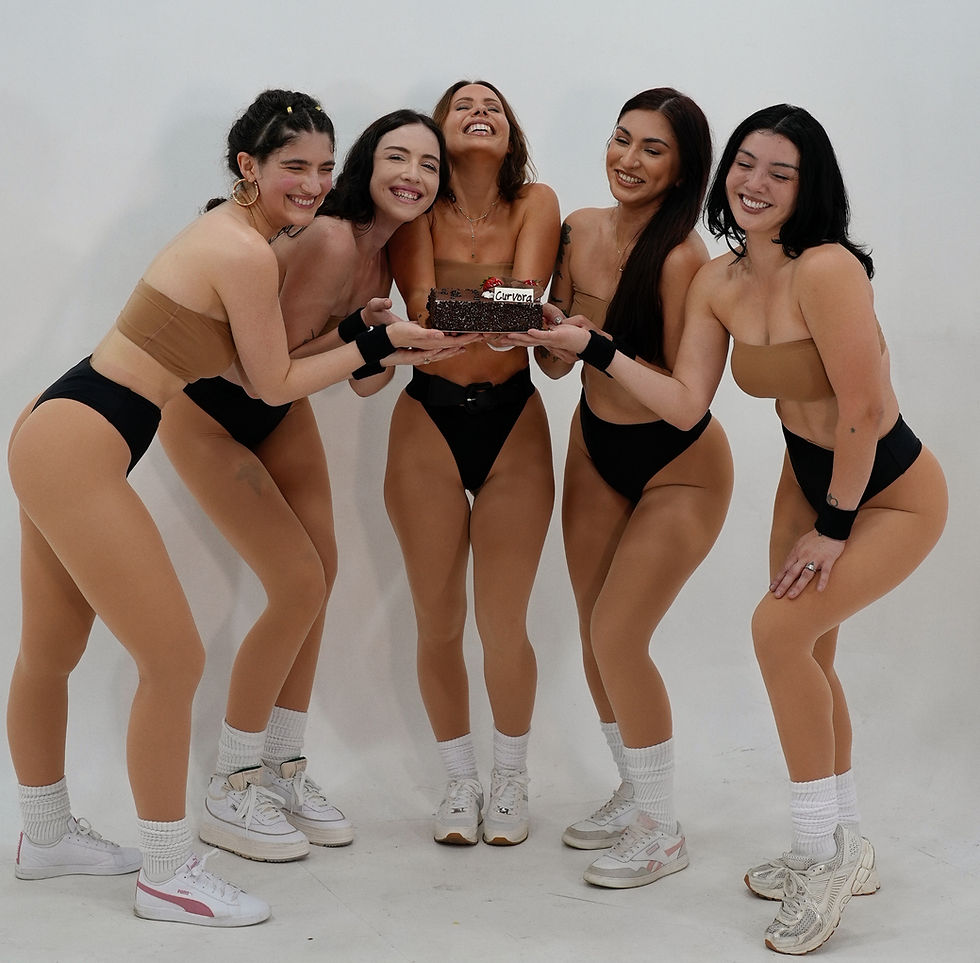
Movement That Transforms
Most traditional workouts target muscles for strength or aesthetics. Curvora does that too—but with intention. Our signature bent-knee, hip-driven movements are designed to engage the body’s deepest stabilizers while freeing up emotional tension we didn’t even know we were carrying.
This isn’t just about looking good. It’s about reclaiming your power, one movement at a time.
The Hips: A Scientific Superpower
Hip Mobility Supports Longevity
A longitudinal study published in the Journal of Aging Research found that declines in hip flexion strength were independently linked to higher all-cause mortality in older women (PMC3058914). Simply put, weaker hips predict earlier mortality.
A 2022 systematic review reinforced this, noting that hip abductor strength is one of the most important predictors of balance, stability, and long-term independence across all ages (PMC10089299).
Mobility tests also support this correlation: slower results on the Timed Up and Go (TUG) test—which directly measures hip and leg power—predicted nearly double the risk of mortality over 12 years (BMC Health Serv Res, 2016).
Even flexibility plays a role. People with greater joint flexibility—especially through the hips—showed lower all-cause mortality during a 12.9-year follow-up (Medical News Today, 2023).
Let that sink in: stronger, more mobile hips can mean a longer, healthier life.

Muscle Mass = Energy Burn + Stability
Curvora emphasizes bent-knee movement to activate large muscle groups: glutes, thighs, core. According to muscle physiology research, building muscle mass can increase metabolic rate and improve insulin sensitivity, posture, and joint health. By focusing on isolated movement patterns that repeat and layer over time, Curvora naturally builds muscle endurance—without the weights.

More Than a Workout—A Way Back to Your Body
If you've ever felt disconnected from your body, you're not alone. Many of us grew up feeling shame about our curves or unsure how to move confidently in our own skin. At Curvora, we use movement as a language—to remind you that you are already powerful, already beautiful, already enough.
Every squat pulse, every hip rotation, every intentional dynamic stretch is a step back to yourself.
Why It Works
Here’s the breakdown of what we do—and why it works:
Element | What It Does |
Bent Knee Posture | Activates lower body muscles, improves joint stability |
Hip Isolation | Improves mobility, coordination, and emotional release |
Repetitive Flow | Builds strength over time and creates neuromuscular memory |
Low-Impact Design | Protects joints while still delivering results |
Dance-Based Movement | Increases adherence and enjoyment—key to long-term change |
Posture, Circulation, and the Power of Movement
Hip tightness affects nearly everyone.Long hours of sitting, poor posture, and emotional stress can all limit hip mobility, disrupting circulation, stability, and spinal alignment.
Regular hip-mobility training can:
Improve posture and core strength
Enhance pelvic and spinal alignment
Boost circulation and lymphatic flow
Relieve tension in the lower back
Support emotional regulation and nervous system balance
By combining rhythm, breath, and targeted mobility work, Curvora™ helps restore equilibrium to the hips and spine—helping the body move the way it was designed to.
The Takeaway
This isn’t just a trend or a pretty Instagram workout. Curvora is backed by science, by somatics, by real-world strength. It’s designed to help you live better, longer, and more confidently.
So when you're pulsing in a deep squat or isolating your hips for the hundredth time—know that it’s not just a move. It’s a message.
You’re allowed to take up space. You’re allowed to feel amazing in your body. You’re allowed to rewrite the story.
To learn more or experience a class, visit www.curvora.com or follow @CurvoraFitness.
References
Harvard Health Publishing. Why Your Hip Flexors Get Tight—and How to Loosen Them. (2022)
Journal of Bodywork and Movement Therapies. Somatic Movement and Emotional Regulation: A Pilot Study. (2018)
Frontiers in Psychology. Embodied Emotion Regulation Through Movement. (2019)
International Journal of Environmental Research and Public Health. Mobility Training and Mental Health Outcomes: A Systematic Review. (2021)
Journal of Aging Research. Hip Flexion Strength and Mortality Risk. (2011) [PMC3058914]
Systematic Review of Hip Abductor Strength and Balance. (2022) [PMC10089299]
BMC Health Services Research. Mobility and Mortality in Older Adults. (2016)
Medical News Today. Flexibility Linked to Longevity. (2023)
Journal of Applied Physiology. Muscle Mass and Metabolic Health. (2017)
Springer Link. Lower-Extremity Lean Mass and Functional Mobility. (2004)


ChatGPT made this caricature for Jeff 💜